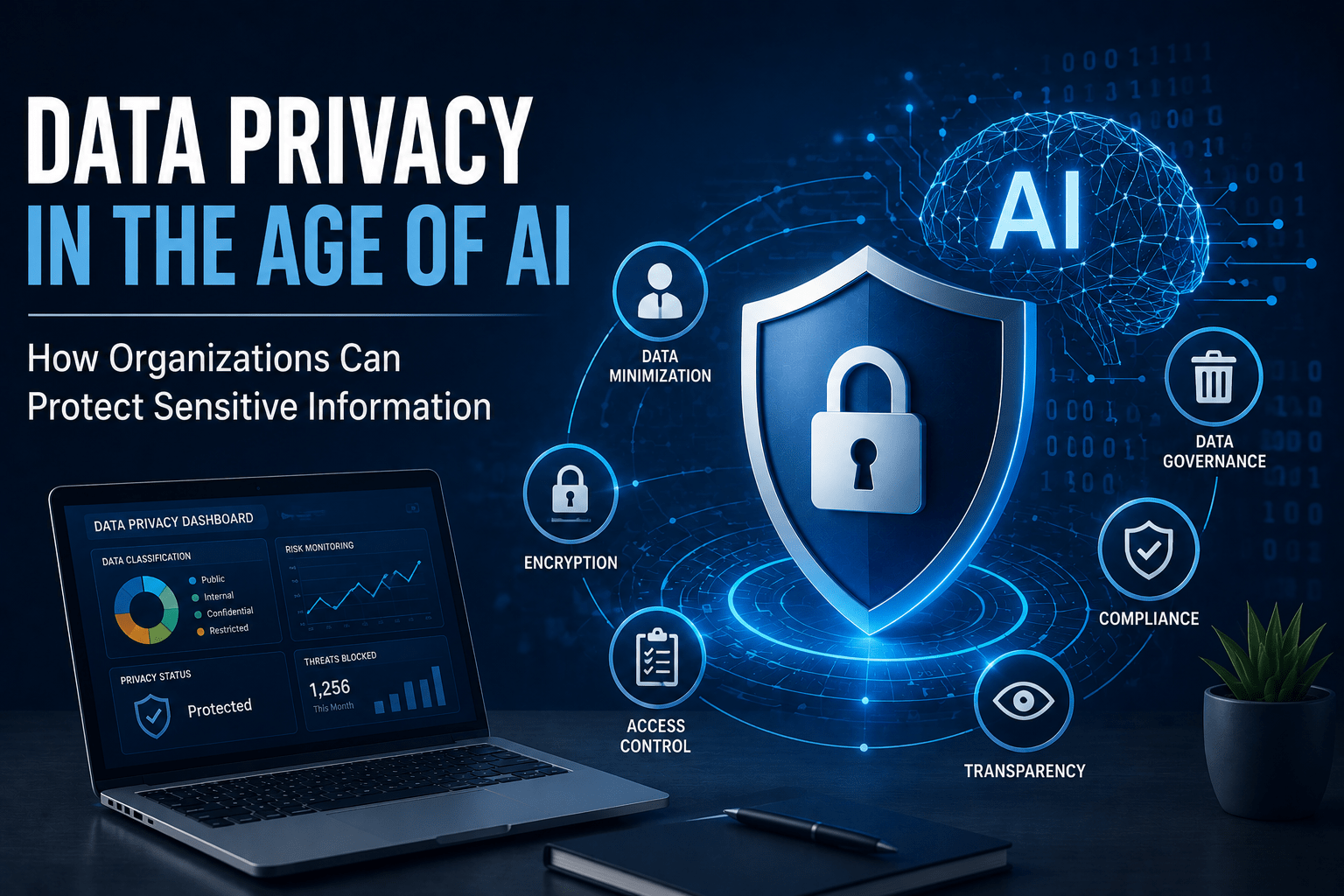
AI tools can aggregate, analyze, and expose sensitive data at a scale and speed that traditional security controls were never designed to handle. Every time an employee pastes client data into ChatGPT, uploads a spreadsheet to an AI analytics tool, or uses an AI-powered assistant to draft a proposal, your organization’s data is potentially leaving your controlled environment — often without anyone realizing it.
Data privacy in 2026 isn’t just about compliance checkboxes. It’s about understanding how AI fundamentally changes the way data moves, who has access to it, and where it ends up.
How AI Changes the Data Privacy Landscape
Before AI became embedded in daily workflows, data privacy risks were relatively contained. You knew where your data lived — in databases, file servers, email systems, and cloud storage. You could draw boundaries around it. Access controls, encryption, and network segmentation worked because data stayed within defined perimeters.
AI disrupts this model in three fundamental ways.
Data leaves your perimeter constantly. When employees use external AI tools, they’re sending data to third-party servers. A marketing manager summarizing client feedback in ChatGPT is transmitting that data to OpenAI’s infrastructure. A finance analyst using an AI tool to reconcile invoices is uploading financial records to a vendor’s cloud. Each interaction is a potential data transfer that your privacy policies may not cover.
AI aggregates data in unpredictable ways. Individual data points that seem harmless in isolation become sensitive when combined. An AI system that ingests employee names, email patterns, project assignments, and calendar data can infer organizational structure, upcoming product launches, and strategic priorities. Aggregation turns low-sensitivity data into high-sensitivity intelligence.
Training data creates persistent exposure. Some AI tools use input data to improve their models. This means information shared with the tool may influence future outputs served to other users. Even if a tool claims not to train on your data today, terms of service change. And once data enters a training pipeline, retrieval or deletion is practically impossible.
The Regulatory Reality
Privacy regulations are catching up to AI, but they haven’t caught up yet. Here’s where things stand.
CCPA and state privacy laws. California’s Consumer Privacy Act and its CPRA amendment give consumers rights over their personal information — including the right to know what’s collected, to delete it, and to opt out of its sale or sharing. Over a dozen other states have enacted similar laws. If your organization handles personal data of residents in these states, you need to account for AI-related processing in your privacy disclosures.
GDPR. For organizations handling data of EU residents, GDPR’s requirements around lawful processing, data minimization, purpose limitation, and data subject rights apply fully to AI use cases. Automated decision-making is specifically addressed in Article 22, which gives individuals the right not to be subject to decisions based solely on automated processing.
HIPAA. If AI tools are processing protected health information, HIPAA applies. Using an AI tool to analyze patient data without a Business Associate Agreement, appropriate safeguards, and documented authorization is a violation — regardless of how convenient the tool is.
Emerging AI-specific regulation. The EU AI Act is now in effect, classifying AI systems by risk level and imposing specific requirements on high-risk applications. In the U.S., federal AI guidelines and state-level AI legislation are multiplying. Organizations that build privacy governance around AI now will be ahead of the regulatory curve.
Where Organizations Are Most Exposed
Shadow AI. Employees using AI tools without organizational approval or oversight. This is the number one privacy risk for most organizations in 2026. A recent survey found that over 75% of knowledge workers use AI tools at work, and a significant portion do so without their employer’s knowledge or approval. Every unauthorized AI interaction is an uncontrolled data transfer.
Vendor AI integration. Your existing SaaS tools are rapidly adding AI features — often enabled by default. Your CRM, project management tool, email platform, and collaboration software may all be processing your data through AI models without explicit configuration. Review vendor terms of service and AI feature settings proactively.
Client data in AI prompts. When employees use AI to draft proposals, analyze datasets, or create reports, they often include real client data. Even if the AI tool doesn’t retain the data, the act of transmitting it may violate client contracts, NDAs, or regulatory requirements.
AI-generated content with embedded data. AI outputs can inadvertently include fragments of training data or previously processed information. If your organization uses AI-generated content externally, there’s a risk of unintentionally disclosing sensitive information embedded in the output.
How to Protect Sensitive Information
Establish an AI use policy. Define which AI tools are approved, what data can and cannot be shared with them, and what approval process is required for new tools. This policy should be specific — not a vague statement about “using AI responsibly” but a clear set of rules. Which tools are approved? Which data classifications are prohibited from AI input? Who approves exceptions?
Classify your data. You can’t protect data you haven’t categorized. Implement a data classification scheme that identifies public, internal, confidential, and restricted data. Map AI use restrictions to each classification level. Restricted data — PII, PHI, financial records, client confidential information — should never enter external AI tools without explicit controls and approval.
Audit your AI tool landscape. Identify every AI tool in use across your organization — both sanctioned and unsanctioned. Review their terms of service, data processing agreements, and privacy policies. Specifically look for language about data retention, model training, and third-party sharing. If a tool trains on your data, either negotiate terms or find an alternative.
Implement technical controls. Data Loss Prevention (DLP) tools can monitor and block sensitive data from being pasted into web-based AI applications. Endpoint controls can restrict access to unauthorized AI tools. API-level controls can prevent sensitive fields from being sent to AI integrations in your SaaS stack.
Update your privacy notices and contracts. If you’re processing personal data through AI tools, your privacy notices to customers and employees need to reflect this. Client contracts and vendor agreements should address AI processing explicitly. Business Associate Agreements under HIPAA must cover any AI tools handling PHI.
Train your workforce. Most AI privacy incidents aren’t malicious — they’re accidental. Employees don’t realize they’re creating risk when they paste data into an AI tool. Regular training that explains the risks with specific examples is far more effective than generic policy documents.
Build privacy into your security program. Data privacy shouldn’t be a separate initiative from cybersecurity. The controls that protect data — access management, encryption, monitoring, incident response — serve both security and privacy objectives. Organizations that integrate privacy into their security program operate more efficiently and avoid gaps between the two disciplines.
The Role of a Security Program in Data Privacy
Privacy and security are two sides of the same coin. Privacy defines what data should be protected and how it can be used. Security provides the controls that enforce those rules.
An organization with a mature security program — documented policies, access controls, risk management, vendor oversight, and incident response — already has most of the infrastructure needed for strong data privacy. The gap is usually in governance: who owns privacy decisions, how are AI tools evaluated, and how are privacy requirements communicated to employees and vendors.
This is where security leadership matters. A vCISO or CISO-as-a-Service provider brings the governance layer that connects security controls to privacy requirements, ensuring that technical protections align with regulatory obligations and business commitments.
How CISOSHARE Supports Data Privacy
CISOSHARE offers dedicated data privacy services designed to integrate directly with your security program. Their approach brings security and privacy together rather than treating them as separate workstreams.
Their data privacy services cover understanding where personal data lives and how it moves through your organization, assessing technical architecture and privacy risk, building policies, processes, and governance for sustained privacy management, supporting privacy notices, vendor terms, and data transfer guidance, preparing for privacy-impacting incidents with response planning, training teams to handle sensitive data correctly, and auditing contracts and reviewing privacy response processes.
CISOSHARE’s team includes resources available to provide legal counsel and support for privacy and security questions, helping organizations prepare for GDPR, CCPA, and other regional or country-specific privacy regulations. Their CISO-as-a-Service model means privacy governance is managed alongside your broader security program — not as a disconnected compliance exercise.
FAQ
What’s the biggest AI-related privacy risk right now?
Shadow AI — employees using unapproved AI tools with company and client data. It’s widespread, largely invisible to leadership, and creates uncontrolled data transfers that violate privacy policies and potentially regulations.
Do we need a separate privacy program or can it be part of our security program?
It should be integrated. Privacy defines the rules for data handling; security enforces them. Organizations that combine both under one program with clear governance avoid gaps and duplication.
How do we know if our AI vendors are handling data properly?
Review their data processing agreements, terms of service, and privacy policies. Look specifically for language about data retention, model training, subprocessor use, and breach notification. If they can’t answer these questions clearly, that’s a red flag.