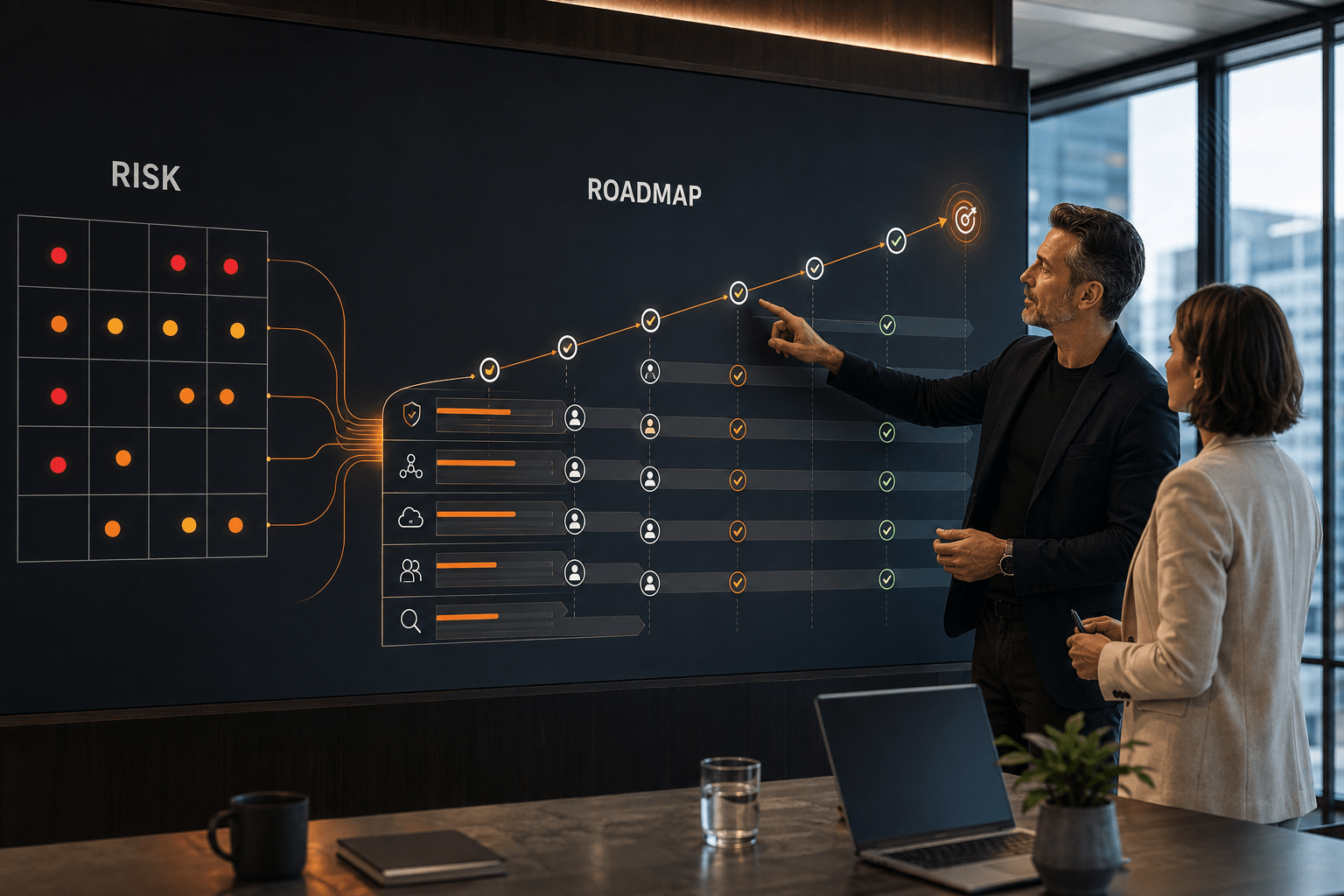
A risk assessment without a roadmap is an expensive inventory of problems. You know where the gaps are. You don’t know what to do first, who owns what, or how to make progress without burning your team out trying to fix everything at once.
Most organizations that complete a risk assessment get a report with dozens of findings ranked by severity. Then they face the real challenge: turning that list into a plan that a non-technical leadership team can approve, a stretched IT team can execute, and an auditor can recognize as a systematic security program.
Here’s how to do that.
Start With Prioritization, Not the List
The first instinct after reading a risk assessment report is to start working through findings by severity. Critical findings first, then high, then medium. It seems logical. It’s usually wrong.
Severity scores reflect technical risk in isolation. They don’t account for your organization’s specific environment, your existing compensating controls, the likelihood of exploitation given your threat landscape, or the business impact of a particular finding compared to another.
A critical finding on a system with no external exposure, no sensitive data, and compensating controls already in place may be a lower practical priority than a high finding on the system that processes all your customer transactions. The risk assessment tells you what’s wrong. Your job is deciding what matters most given the context of your business.
Useful prioritization considers three things: the realistic likelihood of exploitation in your environment, the business impact if the risk materializes, and the cost and effort of remediation relative to the risk it eliminates. When you work through findings with that lens, the ordering often looks different from the raw severity ranking.
Group Findings Into Workstreams
A list of 60 remediation items is impossible to execute as 60 individual tasks. It creates coordination problems, makes progress invisible, and burns out the people responsible for delivery.
The more functional approach is to group related findings into workstreams that can be planned and executed as coherent projects. Access control findings cluster naturally. Network security findings cluster. Policy and documentation gaps cluster. Compliance-specific requirements for each relevant framework cluster.
Workstreams serve several purposes beyond task organization. They let you assign ownership at a level that’s meaningful. A single person or team owns an access control workstream. Someone else owns policy development. A third owns vulnerability management. Ownership without boundaries produces confusion about who’s accountable.
Workstreams also make progress legible to leadership. “We completed 14 of 60 findings” says little. “We completed the access control workstream” conveys a concrete improvement with a recognizable scope.
Build the Roadmap Across Three Horizons
Security programs don’t get fixed in a quarter. A roadmap that tries to address everything immediately produces a budget request that won’t get approved and a team that can’t deliver what it committed to.
CISOSHARE’s security program assessment service produces a comprehensive multi-year roadmap for exactly this reason. The realistic structure organizes remediation across three time horizons.
Immediate (0 to 90 days). High-severity findings with low remediation effort, quick wins that reduce meaningful risk without requiring significant investment, and any compliance gaps that create imminent audit or regulatory risk. This horizon shows leadership that the program is moving without overcommitting resources.
Near-term (3 to 12 months). Workstreams that require planning, budget, or coordination across teams. Compliance framework buildouts, vulnerability management programs, vendor risk processes, and policy overhauls typically land here. These are significant projects, not tasks.
Longer-term (12 to 24+ months). Strategic improvements that require organizational change, significant capital investment, or dependency on near-term work being completed first. Security architecture overhauls, compliance certifications that require months of evidence collection, and maturity model improvements typically sit in this horizon.
The multi-year structure is important for leadership alignment. It prevents the false expectation that a risk assessment produces a one-time remediation sprint. Security is ongoing. The roadmap reflects that.
POA&M: The Document That Turns the Roadmap Into Accountability
A Plan of Action and Milestones, known as a POA&M, is the operational artifact that gives the roadmap teeth. Where a roadmap shows direction, the POA&M shows accountability. It lists every open finding, the specific action being taken to address it, who owns that action, and when it’s expected to close.
CISOSHARE’s security program assessment explicitly includes POA&M development as a deliverable. The reason is straightforward: a roadmap without a POA&M is a strategic document that nobody checks against. A POA&M turns intentions into tracked commitments.
For compliance purposes, a well-maintained POA&M is also evidence. Auditors reviewing your CMMC, FedRAMP, or NIST-aligned program want to see that you track open risks and manage them to closure. An up-to-date POA&M demonstrates a managed process, not just a completed checklist.
Update your POA&M monthly. When findings close, mark them closed with a completion date and the evidence. When new findings emerge from ongoing vulnerability management or incident reviews, add them. The POA&M should reflect the current state of your remediation program at any point in time.
Resource and Budget Planning
A security roadmap without a resource plan is a wishlist. Before presenting the roadmap to leadership for approval, you need estimates for what each workstream requires in terms of time, staffing, tooling, and external support.
Some findings can be addressed by your existing team with existing tools. Changing a configuration, updating an access control policy, enforcing MFA on a system that already supports it. These cost effort, not dollars.
Others require investment. A vulnerability management program that doesn’t exist needs tooling and either internal staff or a managed service to run it. A compliance certification requires external auditor fees. Penetration testing costs money. Policy development across dozens of areas requires either significant internal time or professional services.
Presenting the roadmap alongside a realistic resource estimate lets leadership make an informed decision about sequencing. When budget is constrained, they can approve the immediate and near-term workstreams and plan for the longer-term investments in the next budget cycle. This is more useful than presenting an unfunded wishlist and watching approval stall.
Communicating the Roadmap to Leadership
The risk assessment report is for security practitioners. The roadmap presentation is for leadership. They’re different documents for different audiences.
Leadership needs to understand three things from the roadmap presentation: what the current risk exposure is, what the plan addresses and in what order, and what approving the plan commits the organization to in terms of resources and timeline.
CISOSHARE’s security assessments produce business-first reporting with findings in business context and priority. The roadmap follows the same logic. Each workstream should be framed in terms of what risk it addresses, what the business impact of that risk is, and what completion looks like. Technical detail belongs in the supporting documentation, not the executive summary.
Keep the leadership presentation to a single page or a short slide deck. Findings with context. Workstreams with owners and timelines. Budget implications summarized. A clear ask for what you need approved.
What Comes After the Roadmap
A roadmap is a starting point. Executing it requires ongoing oversight, regular progress reviews, and updates as the threat landscape and business environment change.
Vulnerability management runs continuously and feeds new findings into the POA&M. Compliance programs generate ongoing evidence requirements. Incidents reveal gaps the risk assessment didn’t surface. The roadmap should be reviewed and updated at least quarterly.
Annual risk assessments reset the baseline and capture how the security program has matured since the last assessment. If the work described in the roadmap was executed well, the second assessment should show meaningful risk reduction. If it wasn’t, the second assessment tells you where the program fell behind.
For organizations that need help building and executing a security roadmap after an assessment, the vCISO first 90 days guide shows what the early execution phase typically looks like in a managed engagement. For the risk management process that feeds your roadmap and POA&M over time, the cybersecurity risk management program guide covers the ongoing process.
FAQ
How long should a security roadmap cover?
Most practical roadmaps span 18 to 24 months across three planning horizons. Shorter than that doesn’t account for the time required to execute significant workstreams. Longer becomes speculative because the security environment changes faster than multi-year plans can track.
Who should own the roadmap?
The security leader — whether internal CISO, vCISO, or CISO-as-a-Service provider — owns the roadmap as a whole. Individual workstream owners are the people accountable for delivering specific projects within it. Without both levels of ownership, the roadmap tends to drift.
How often should the roadmap be updated?
Quarterly reviews are the practical minimum. Major updates follow annual risk assessments. If a significant incident occurs or the threat landscape changes materially, an ad hoc update is warranted rather than waiting for the next scheduled review.
CISOSHARE’s security program assessment produces a practical multi-year roadmap you can start executing immediately. Schedule a call to discuss what that looks like for your organization.