The difference between a good vCISO provider and a bad one is the difference between a security program that works and an expensive advisory relationship that produces nothing actionable. Not all providers deliver equal value, and choosing the wrong one can set your security posture back months.
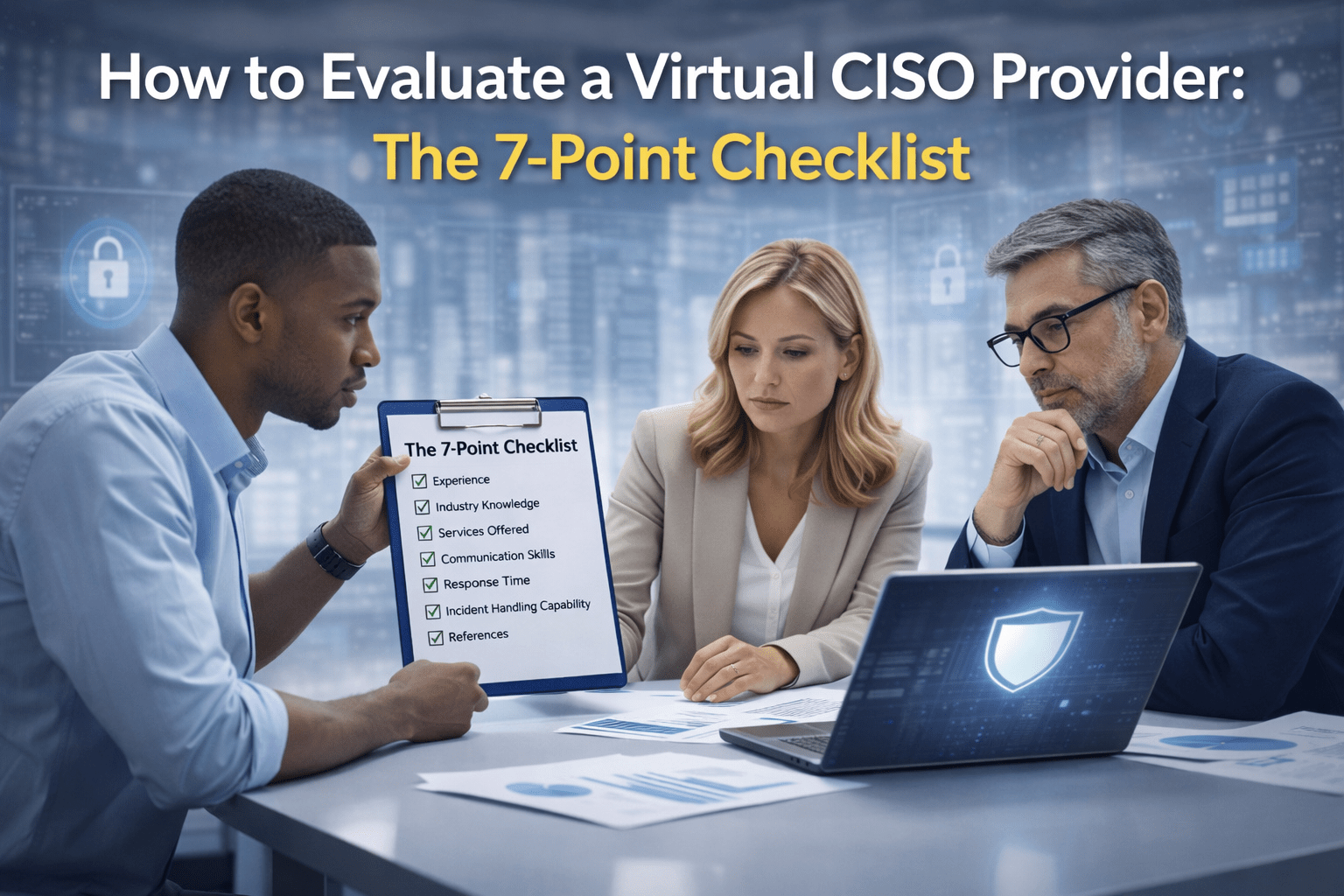
Before you sign a contract, use this 7-point checklist to evaluate whether a virtual CISO provider can actually deliver what your organization needs.
1. Do They Implement, or Just Advise?
This is the single most important question. Many vCISO providers operate as advisory-only services. They’ll assess your environment, hand you a report with recommendations, and leave. The execution falls on your team — a team that likely doesn’t have the expertise or bandwidth to act on those recommendations. That’s why you were looking for a vCISO in the first place.
What to ask: “After you deliver recommendations, who implements them? Will your team build the policies, configure the controls, and prepare us for audits — or is that our responsibility?”
Green flag: The provider offers a CISO-as-a-Service model that includes both the strategic leader and an execution team. They write the policies. They build the documentation. They prepare you for audits. They manage the program.
Red flag: The provider delivers assessments and reports but expects you to execute independently. If you had the internal capability to do that, you wouldn’t need a vCISO.
2. Do They Have Experience With Organizations Like Yours?
A vCISO who has spent their career securing Fortune 500 enterprises may not understand the constraints of a 100-person nonprofit. Similarly, a provider focused on tech startups may not know HIPAA or California’s Data Exchange Framework. Industry and size alignment matter.
What to ask: “Can you share references from organizations similar to ours in size, industry, and compliance requirements? What specific frameworks have you implemented for those clients?”
Green flag: They can name specific clients (with permission), describe comparable engagements, and demonstrate familiarity with your regulatory environment. They understand your budget constraints and don’t try to sell enterprise-grade solutions to a mid-market organization.
Red flag: Vague responses like “we work with all industries” without specifics. No case studies or references from organizations in your sector or size range.
3. What’s Their Methodology?
A qualified vCISO provider doesn’t wing it. They follow a structured, repeatable methodology that has been refined across dozens or hundreds of engagements. This methodology should cover assessment, program development, implementation, and ongoing operations.
What to ask: “Walk me through your engagement methodology from start to finish. What happens in the first 30 days? 90 days? What are the specific deliverables at each stage?”
Green flag: They can articulate a clear process. For example, CISOSHARE follows a proven methodology — first published in the CISO Handbook (2005) — that assesses your current state, builds the security program and controls, then operates and manages it ongoing. Each phase has defined deliverables and timelines, and their learning-and-teaching approach ensures your team builds capability alongside the program.
Red flag: No structured methodology. Every engagement is “custom” without a foundation of repeatable processes. Custom is good for tailoring, but the framework itself should be proven.
4. Who Actually Does the Work?
Many large firms sell the engagement with senior partners, then staff it with junior consultants. You meet the impressive CISO at the pitch meeting, then spend your engagement working with a 25-year-old analyst who’s learning on your dime.
What to ask: “Who will be my primary point of contact? What are their qualifications and experience level? Will I have consistent team members, or will staff rotate?”
Green flag: You meet your actual vCISO before signing. They have relevant certifications (CISSP, CISM, CISA) and genuine CISO-level experience — not just consulting experience. The team assigned to your account is consistent, not a rotating pool.
Red flag: You only interact with sales during the evaluation process. The proposal doesn’t name specific team members. They can’t commit to who will be assigned to your account.
5. How Do They Handle Compliance Across Multiple Frameworks?
Most organizations don’t face a single compliance requirement. You might need HIPAA for health data, SOC 2 for client trust, ISO 27001 for international partnerships, and state privacy laws for your jurisdiction. A good vCISO provider manages the overlap efficiently instead of treating each framework as a separate project.
What to ask: “We need to address [list your frameworks]. How do you manage overlapping requirements across multiple compliance standards? Do you map controls across frameworks or treat them separately?”
Green flag: They use a unified control framework approach. They map your controls once and demonstrate compliance across multiple standards simultaneously. This reduces duplication, saves time, and keeps costs manageable.
Red flag: They treat each compliance framework as a separate billable project. This leads to redundant work, higher costs, and fragmented documentation.
6. What Does Pricing Look Like — And What’s Included?
Pricing transparency is essential. Some providers quote low monthly retainers but charge extra for assessments, policy development, audit preparation, and incident support. Others provide all-inclusive pricing with clear deliverables.
What to ask: “What exactly is included in your monthly retainer? What activities or deliverables would be considered out-of-scope and billed separately? Can you provide a sample statement of work?”
Green flag: Clear, predictable pricing with a defined scope. Typical vCISO retainers range from $2,500 to $10,000/month, depending on complexity. The provider can articulate exactly what you get for that investment. No surprises.
Red flag: Vague pricing with “it depends” answers and no willingness to provide ranges. Heavy reliance on hourly billing without caps. Scope definitions that leave room for surprise charges.
Pricing benchmarks to know:
- Startups and small organizations: $1,000–$3,000/month
- Mid-market companies: $4,000–$8,000/month
- Larger or more complex engagements: $8,000–$15,000+/month
- Full-time in-house CISO comparison: $250,000–$500,000+/year
7. What’s Their Track Record With Audit Outcomes?
Ultimately, a vCISO’s effectiveness is measured by outcomes. Can they get you through audits? Have their clients achieved the certifications they pursued? What’s the success rate?
What to ask: “How many clients have you taken through [specific audit/certification]? What’s your pass rate? Can you share examples of organizations that achieved compliance through your engagement?”
Green flag: Specific, verifiable claims. For example, a provider that can say “we’ve taken 50+ organizations through SOC 2 audits with a 100% pass rate” is demonstrating concrete results. Bonus points if they can share client testimonials with real names and companies.
Red flag: No specific audit outcome data. Claims of expertise without evidence. Testimonials that are anonymous or vague.
The Evaluation Scorecard
Before making your decision, score each provider on these seven criteria. Rate each from 1–5:
| Criteria | Provider A | Provider B | Provider C |
| Implementation vs. advisory | _/5 | _/5 | _/5 |
| Industry and size alignment | _/5 | _/5 | _/5 |
| Structured methodology | _/5 | _/5 | _/5 |
| Team qualifications and consistency | _/5 | _/5 | _/5 |
| Multi-framework compliance | _/5 | _/5 | _/5 |
| Pricing transparency | _/5 | _/5 | _/5 |
| Audit track record | _/5 | _/5 | _/5 |
| Total | _/35 | _/35 | _/35 |
Any provider scoring below 25 should raise concerns. A score of 30+ indicates a strong fit.
Bringing It Together
The vCISO market has grown significantly, which means you have more choices than ever — but also more risk of choosing a provider that oversells and underdelivers. The seven points above are designed to cut through marketing and evaluate what actually matters: can this provider build, implement, and manage a security program that protects your organization and satisfies your compliance requirements?
Take the time to evaluate properly. A bad vCISO engagement doesn’t just waste money — it gives you a false sense of security while leaving real gaps unaddressed.
For a broader view of the market, see our Top 10 Virtual CISO Service Providers in 2026.
FAQ
How many vCISO providers should I evaluate?
Aim for 3–5 providers to get a meaningful comparison. Fewer than 3 limits your perspective. More than 5 creates evaluation fatigue without adding clarity.
Should I choose a local or remote vCISO?
Most vCISO work is done remotely, so geography matters less than expertise and fit. However, if you value periodic on-site presence, ask whether the provider offers hybrid engagement models.
How long should a vCISO contract be?
Initial contracts are typically 6–12 months. Avoid providers requiring multi-year commitments upfront. A confident provider will earn your renewal through results.
What certifications should a vCISO have?
Look for CISSP, CISM, or CISA as baseline certifications. Industry-specific knowledge (HIPAA, PCI, ISO) is equally important. Experience matters more than certification count.
Can I switch vCISO providers if it’s not working?
Yes, but transitions take time. Ensure your contract includes provisions for documentation handoff and transition support. All security documentation should be yours, not the provider’s.
CISOSHARE’s vCISO services deliver implementation, not just advisory. Schedule a call to see how we score on this checklist.