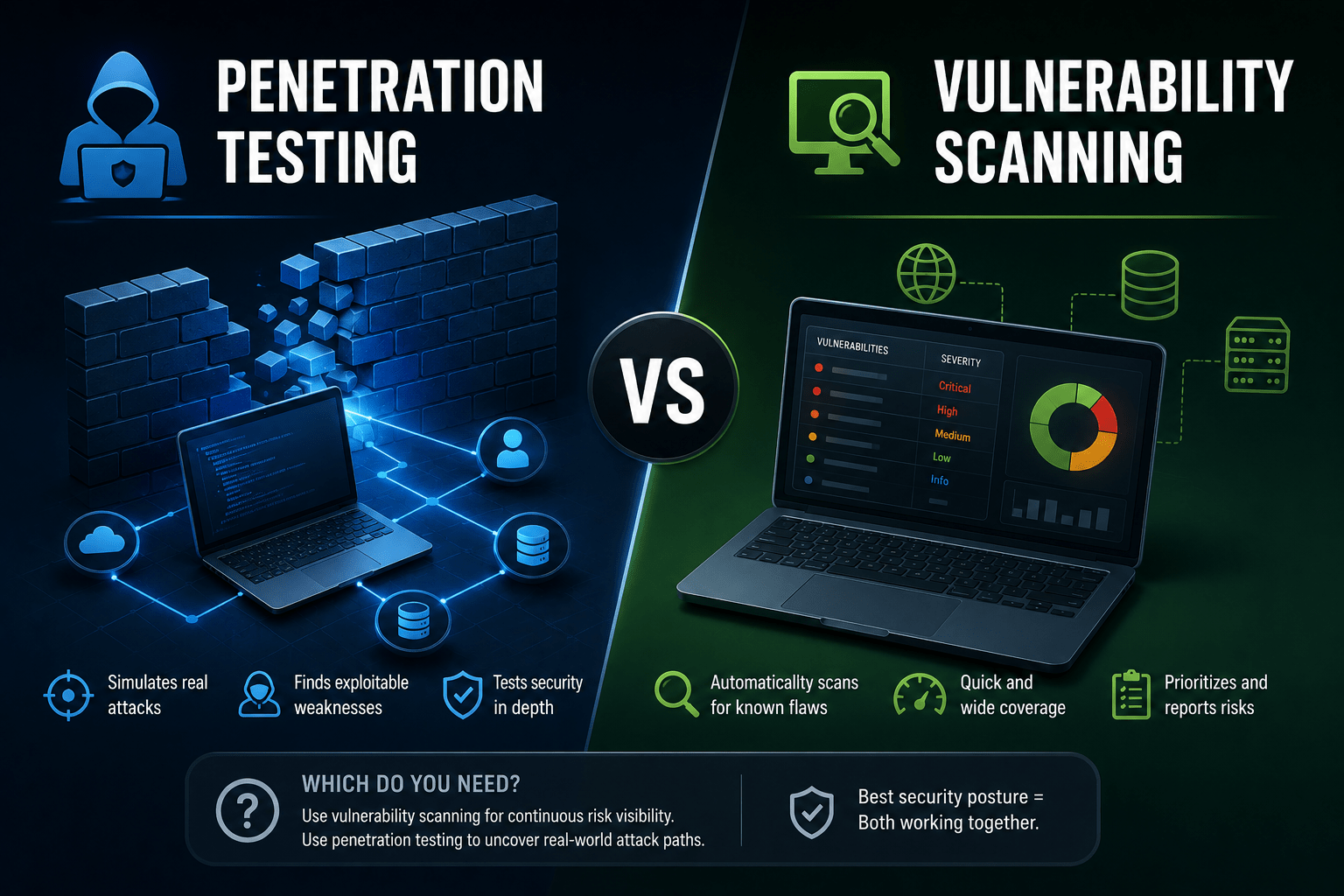
Vulnerability scanning identifies known weaknesses in your systems automatically. Penetration testing simulates how a real attacker would exploit those weaknesses to break in. You need both — scanning for breadth across your entire environment, and penetration testing for depth into how those vulnerabilities can actually be used against you.
Most organizations confuse the two or assume one replaces the other. They don’t. Understanding what each does, when to use it, and how they work together is essential for building an effective security program.
Vulnerability Scanning: The Wide-Angle View
A vulnerability scan is an automated process that examines your systems, applications, and network devices against a database of known vulnerabilities. The scanner checks for missing patches, misconfigurations, default credentials, outdated software, and other known weaknesses.
How it works: The scanning tool connects to your systems — either with credentials (authenticated scan) or without (unauthenticated scan) — and systematically checks each system against its vulnerability database. An authenticated scan provides deeper results because it can see inside the system. An unauthenticated scan shows what an outsider can see from the network.
What you get: A report listing every identified vulnerability, typically scored using the Common Vulnerability Scoring System (CVSS) from 0 to 10. The report includes CVE identifiers, descriptions, affected systems, and recommended remediation steps.
What it doesn’t do: A vulnerability scan doesn’t tell you whether a vulnerability can actually be exploited in your specific environment. A finding rated “critical” by CVSS might be completely unexploitable due to your network architecture, compensating controls, or system configuration. The scan identifies possibilities — not confirmed threats.
Typical cadence: Monthly or weekly for most environments. Weekly for internet-facing systems and environments handling sensitive data. Many compliance frameworks require at a minimum quarterly scanning, but monthly is the practical standard.
Cost: Relatively low. Scanning tools range from free (OpenVAS) to $5,000–$20,000 annually for commercial solutions like Nessus, Qualys, or Rapid7. Managed vulnerability scanning services typically run $500–$3,000/month, depending on the environment size.
Penetration Testing: The Attacker’s Perspective
A penetration test is a manual, expert-driven exercise where security professionals simulate a real attack against your environment. They don’t just identify vulnerabilities — they attempt to exploit them, chain them together, and demonstrate exactly how an attacker could compromise your systems, access your data, or disrupt your operations.
How it works: Penetration testers follow a methodology that mirrors how actual attackers operate. They begin with reconnaissance and discovery — gathering information about your systems, network, and configurations. Then they identify vulnerabilities and attempt to exploit them. If they gain access, they attempt to move laterally through your environment, escalate privileges, and access sensitive data. Every step is documented.
What you get: A detailed report showing not just what vulnerabilities exist, but how they were exploited, what data or systems were accessed, and what the real-world business impact could be. The report includes a prioritized remediation plan based on actual exploitability — not theoretical CVSS scores.
What it doesn’t do: A pen test is a point-in-time assessment. It tells you how your defenses performed during the test period, but your environment changes constantly. New vulnerabilities appear daily. That’s why pen testing complements ongoing vulnerability scanning — scanning maintains continuous visibility, while pen testing provides periodic deep validation.
Types of penetration testing:
External penetration testing targets your internet-facing systems — websites, email servers, VPNs, and cloud services. This simulates an attacker coming from outside your network with no prior access or inside knowledge.
Internal penetration testing simulates an attacker who has already gained initial access to your network — perhaps through a phishing email or a compromised employee account. This tests how far an attacker can go once they’re inside.
Web application testing evaluates your web applications for vulnerabilities like SQL injection, cross-site scripting, authentication flaws, and other common attack vectors.
Social engineering testing targets your people rather than your technology. Phishing emails, phone pretexting, and physical security tests assess whether employees follow security procedures under realistic attack conditions.
Wireless penetration testing evaluates the security of your wireless networks, access points, and configurations.
Typical cadence: Annually at minimum, with additional tests after major infrastructure changes, application deployments, or significant organizational changes. Many compliance frameworks require annual penetration testing.
Cost: Significantly higher than scanning. A focused external pen test typically costs $5,000–$15,000. A comprehensive internal and external assessment can range from $15,000–$50,000+, depending on scope and complexity.
Side-by-Side Comparison
| Factor | Vulnerability Scanning | Penetration Testing |
|---|---|---|
| Approach | Automated tool | Manual, expert-driven |
| Scope | Broad — entire environment | Focused — specific targets |
| Depth | Surface-level identification | Deep exploitation and validation |
| Output | List of known vulnerabilities | Proven attack paths with business impact |
| Frequency | Monthly or weekly | Annually or after major changes |
| Duration | Hours | Days to weeks |
| Cost | Low ($500–$3,000/month) | Higher ($5,000–$50,000+ per engagement) |
| Skill required | Can be automated/managed | Requires experienced security professionals |
| Compliance | Required by most frameworks | Required by most frameworks |
| Best for | Continuous monitoring, coverage | Validating real-world exploitability |
Why You Need Both
Relying on scanning alone gives you a false sense of coverage. You see thousands of findings but don’t know which ones actually matter. Your team burns out chasing low-risk items while genuinely exploitable vulnerabilities sit unnoticed because the CVSS score didn’t flag them as critical in your specific context.
Relying on pen testing alone gives you periodic depth without continuous coverage. You get an excellent snapshot once a year, but vulnerabilities introduced next month go undetected until the next test.
The effective approach combines both. Vulnerability scanning runs continuously to maintain visibility across your environment and feed your remediation process. Penetration testing runs annually or after significant changes to validate that your defenses actually work against a motivated attacker.
The findings from each inform the other. Pen test results should refine how you prioritize scan findings. Scan results should help scope pen tests to focus on the highest-risk areas. Together, they create a complete picture that neither provides alone.
Which Compliance Frameworks Require What?
PCI DSS: Requires both quarterly vulnerability scanning (by an Approved Scanning Vendor for external scans) and annual penetration testing.
HIPAA: Requires risk assessments that include vulnerability identification. Pen testing is not explicitly mandated, but is widely considered a best practice and expected by auditors.
SOC 2: Requires evidence of vulnerability management. Penetration testing demonstrates control effectiveness and is increasingly expected by auditors.
ISO 27001: Requires vulnerability management as part of the ISMS. Pen testing supports compliance with Annex A technical controls.
CMMC: Requires vulnerability scanning and remediation. Penetration testing is expected at Level 2 and above to validate control effectiveness.
How CISOSHARE Approaches Pen Testing and Vulnerability Management
CISOSHARE offers both penetration testing and vulnerability management as distinct but connected services.
Their penetration testing services go beyond generating a lengthy list of items that need remediation. CISOSHARE conducts thorough and customized pen tests based on an understanding of your environment’s unique configuration. They begin with a discovery phase to gather information about available systems and how they’re configured, then identify and test vulnerabilities to determine if they can be exploited to gain unauthorized access, extract data, or move throughout the network. All reports and recommendations are generated with remediation and business impact in mind.
Their pen testing covers external and internal network testing, web application testing, wireless penetration testing, social engineering, including phishing and physical security, and medical device and IoT testing.
For ongoing vulnerability management, CISOSHARE’s managed services regularly assess your environment to identify and remediate vulnerabilities before they’re exploited. Pen tests are scheduled as part of the managed program — typically annually or quarterly — adding context and validation to the continuous vulnerability management process.
Both services integrate into your broader security program, connecting findings to risk management, compliance evidence, and remediation tracking.
FAQ
Can we just do penetration testing and skip vulnerability scanning?
No. Pen testing is periodic and focused. Without continuous scanning, vulnerabilities introduced between pen tests go undetected. You need scanning for ongoing coverage and pen testing for periodic deep validation.
How do we choose a penetration testing provider?
Look for providers who customize their approach to your environment rather than running generic automated tools. Ask for sample reports, verify their methodology, and ensure they provide actionable remediation guidance — not just a list of findings.
Should vulnerability scanning be internal or outsourced?
For most mid-size organizations, outsourced vulnerability management is more effective. It provides consistent cadence, expert prioritization, remediation tracking, and compliance documentation without requiring internal security headcount.