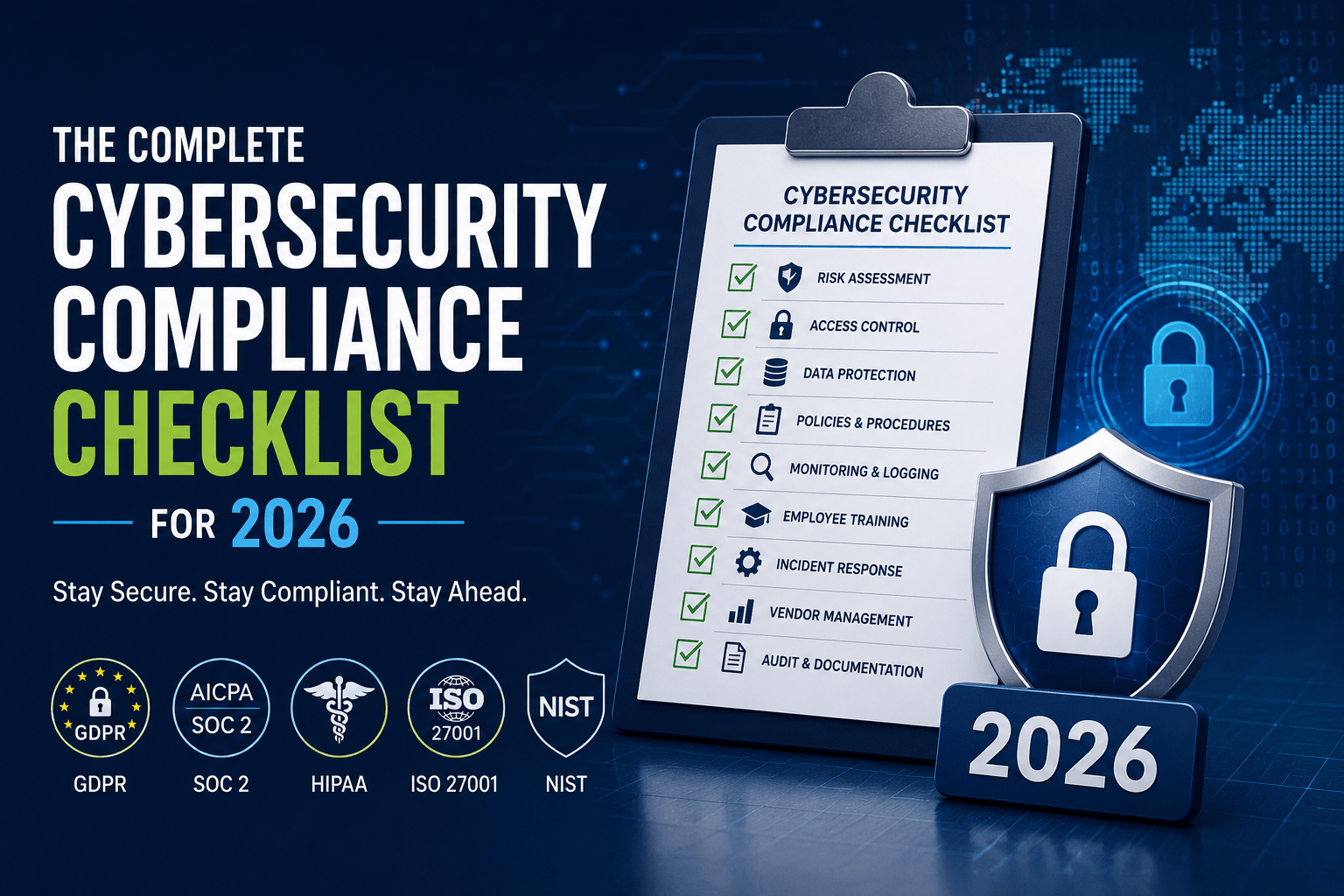
Cybersecurity compliance means meeting the specific security requirements set by regulations, industry standards, or contractual obligations that apply to your organization. If you handle health data, you need HIPAA. If enterprise clients ask for proof of security, you likely need SOC 2. If you work with the Department of Defense, CMMC is mandatory. And if you operate internationally, ISO 27001 is the gold standard.
The challenge is that most growing organizations don’t face just one framework — they face several, often with overlapping requirements and different audit timelines. This guide breaks down the major compliance frameworks in 2026, explains who needs what, and provides a practical checklist to help you prioritize.
HIPAA: Healthcare Data Protection
What it is: The Health Insurance Portability and Accountability Act sets national standards for protecting sensitive patient health information (PHI). It applies to any organization that creates, receives, stores, or transmits protected health information.
Who needs it: Healthcare providers, health plans, healthcare clearinghouses, and any business associate that handles PHI on their behalf. This includes many nonprofits that manage community health programs, behavioral health services, or social services involving health records.
Core requirements: The Privacy Rule governs how PHI can be used and disclosed. The Security Rule requires administrative, physical, and technical safeguards for electronic PHI. The Breach Notification Rule mandates notification to affected individuals and HHS within 60 days of a breach discovery.
Your checklist:
- Conduct an annual risk assessment, identifying threats to ePHI
- Document and implement privacy and security policies
- Execute Business Associate Agreements with all vendors handling PHI
- Implement encryption for data at rest and in transit
- Establish access controls based on role and minimum necessary access
- Train all workforce members who handle PHI at onboarding and annually
- Build and test an incident response plan with breach notification procedures
- Maintain audit logs of access to systems containing ePHI
Penalty range: $141 to $2,134,831 per violation, with annual maximums exceeding $2 million per category.
Learn more about CISOSHARE’s HIPAA compliance services →
SOC 2: Proving Security to Your Clients
What it is: SOC 2 (System and Organization Controls 2) is an attestation framework developed by the AICPA. It evaluates how well an organization protects customer data based on five Trust Services Criteria: Security, Availability, Processing Integrity, Confidentiality, and Privacy.
Who needs it: Any service organization that stores, processes, or transmits customer data — particularly SaaS companies, managed service providers, data processors, and any organization whose clients require proof of security controls. Increasingly, enterprise clients won’t sign contracts without a SOC 2 Type II report.
Core requirements: Security is the mandatory baseline criterion. Organizations then select which additional criteria apply to their services. A Type I report evaluates control design at a point in time. A Type II report evaluates control effectiveness over a period (typically 6–12 months) and carries significantly more weight with clients.
Your checklist:
- Define your audit scope (systems, data, and processes in scope)
- Select which Trust Services Criteria apply beyond Security
- Implement and document controls for each criterion
- Establish continuous monitoring and evidence collection processes
- Conduct a readiness assessment before engaging your auditor
- Engage an AICPA-qualified CPA firm for the attestation
- Build a timeline: plan for 3–6 months of evidence collection for Type II
- Prepare for annual SOC 2 renewals — this is an ongoing commitment
Learn more about CISOSHARE’s SOC readiness services →
ISO 27001: The International Gold Standard
What it is: ISO 27001 is an international standard that specifies requirements for establishing, implementing, maintaining, and continually improving an Information Security Management System (ISMS). Certification is granted through a third-party audit and is recognized worldwide.
Who needs it: Organizations that operate internationally, serve enterprise clients who require ISO certification, or want a comprehensive, risk-based framework for managing security. ISO 27001 is increasingly requested by partners, clients, and regulators across all industries.
Core requirements: The standard requires a formal ISMS with defined scope, a risk assessment methodology, a Statement of Applicability mapping controls to identified risks, and a commitment to continual improvement. Annex A contains 93 controls across organizational, people, physical, and technological categories.
Your checklist:
- Define your ISMS scope (what information and systems are included)
- Conduct a formal risk assessment using a documented methodology
- Develop your Statement of Applicability, mapping risks to controls
- Build or update policies covering all relevant Annex A control areas
- Implement technical, physical, and administrative controls
- Train personnel on their ISMS roles and responsibilities
- Conduct an internal audit before the certification audit
- Complete a management review demonstrating leadership engagement
- Engage a certification body for Stage 1 (documentation) and Stage 2 (implementation) audits
- Plan for annual surveillance audits and triennial recertification
Learn more about CISOSHARE’s ISO 27001 certification services →
CMMC: Defense Contractor Compliance
What it is: The Cybersecurity Maturity Model Certification is a DoD requirement for organizations in the defense supply chain that handle Federal Contract Information (FCI) or Controlled Unclassified Information (CUI). CMMC 2.0 streamlines the original model into three levels.
Who needs it: Defense contractors, subcontractors, and any supplier in the defense industrial base that accesses, processes, or stores FCI or CUI. If you bid on DoD contracts, CMMC compliance is now a requirement — not optional.
Core requirements: Level 1 (Foundational) requires 17 basic cybersecurity practices and allows annual self-assessment. Level 2 (Advanced) aligns with NIST SP 800-171 Rev 2 and requires 110 practices, with a third-party assessment every three years for critical CUI handlers. Level 3 (Expert) adds NIST SP 800-172 controls for advanced persistent threat protection.
Your checklist:
- Determine your CMMC level based on the type of information you handle
- Conduct a gap assessment against NIST SP 800-171 requirements
- Develop a System Security Plan (SSP) documenting your controls
- Create and maintain a Plan of Action and Milestones (POA&M) for gaps
- Implement required controls across all 14 NIST 800-171 control families
- Establish an incident response capability with DoD reporting procedures
- Prepare evidence and documentation for assessment
- Engage a Certified Third-Party Assessment Organization (C3PAO) for Level 2+
- Maintain ongoing compliance — CMMC is not a one-time certification
Learn more about CISOSHARE’s CMMC consulting services →
Other Frameworks to Consider
Beyond the four major frameworks above, organizations may also need to address NIST Cybersecurity Framework (voluntary but widely adopted as a baseline for security programs), HITRUST CSF (healthcare-specific certification integrating HIPAA, NIST, and ISO requirements), PCI DSS (mandatory for any organization processing credit card payments, including nonprofits accepting card donations), and GDPR/CCPA (data privacy regulations for organizations handling EU citizen or California resident data).
Why Smart Organizations Map Controls Across Frameworks
Treating each framework as a separate project is the most common and expensive mistake. Access controls, encryption, risk assessment, incident response, and vendor management appear in virtually every standard. Organizations that build one security program and map it to multiple frameworks save time, reduce audit fatigue, and build stronger security. For example, implementing ISO 27001 as your foundation addresses roughly 60–70% of SOC 2 requirements and significant portions of HIPAA.
How CISOSHARE Helps With Compliance
CISOSHARE offers compliance and best practice services across all the frameworks covered in this guide: HIPAA, SOC 2, ISO 27001, CMMC, PCI DSS, NIST, HITRUST, and data privacy regulations, including GDPR and CCPA.
Their approach focuses on building a unified security program as the foundation, then mapping that program’s controls to whichever frameworks your organization needs to satisfy. This avoids the common trap of treating each certification as a separate, expensive project.
CISOSHARE’s team has helped organizations like Material+ achieve SOC 2 Type 1 and Type 2 certifications over multiple years, guided Word & Brown Companies in building a security program supporting multiple compliance needs across a complex corporate family, and helped Beta Research Corp turn compliance into a business enabler — securing new partnerships that required proof of data protection.
Whether you need a single framework or multi-framework compliance, CISOSHARE’s CISO-as-a-Service model provides the leadership and execution team to assess your current state, build the program, and manage ongoing compliance.
FAQ
Which compliance framework should I start with?
Start with the framework that has the most immediate business impact — usually the one your clients or partners are asking about. If no specific framework is required, NIST CSF provides the broadest foundation that maps well to other standards.
Can I pursue multiple compliance frameworks at the same time?
Yes, and it’s often more efficient than pursuing them sequentially. Frameworks share significant control overlap, so building a unified program and mapping controls across standards reduces redundant work.
Do I need a full-time compliance team?
Not necessarily. Many organizations use a vCISO or CISO-as-a-Service provider to manage compliance alongside other security program responsibilities. This is particularly effective for mid-size organizations and nonprofits.