Getting quotes for vCISO services without understanding the pricing structure is like buying a car based on the monthly payment without checking the terms. A $4,000 retainer can be a great deal. An $8,000 retainer can be a waste. The number tells you almost nothing on its own.
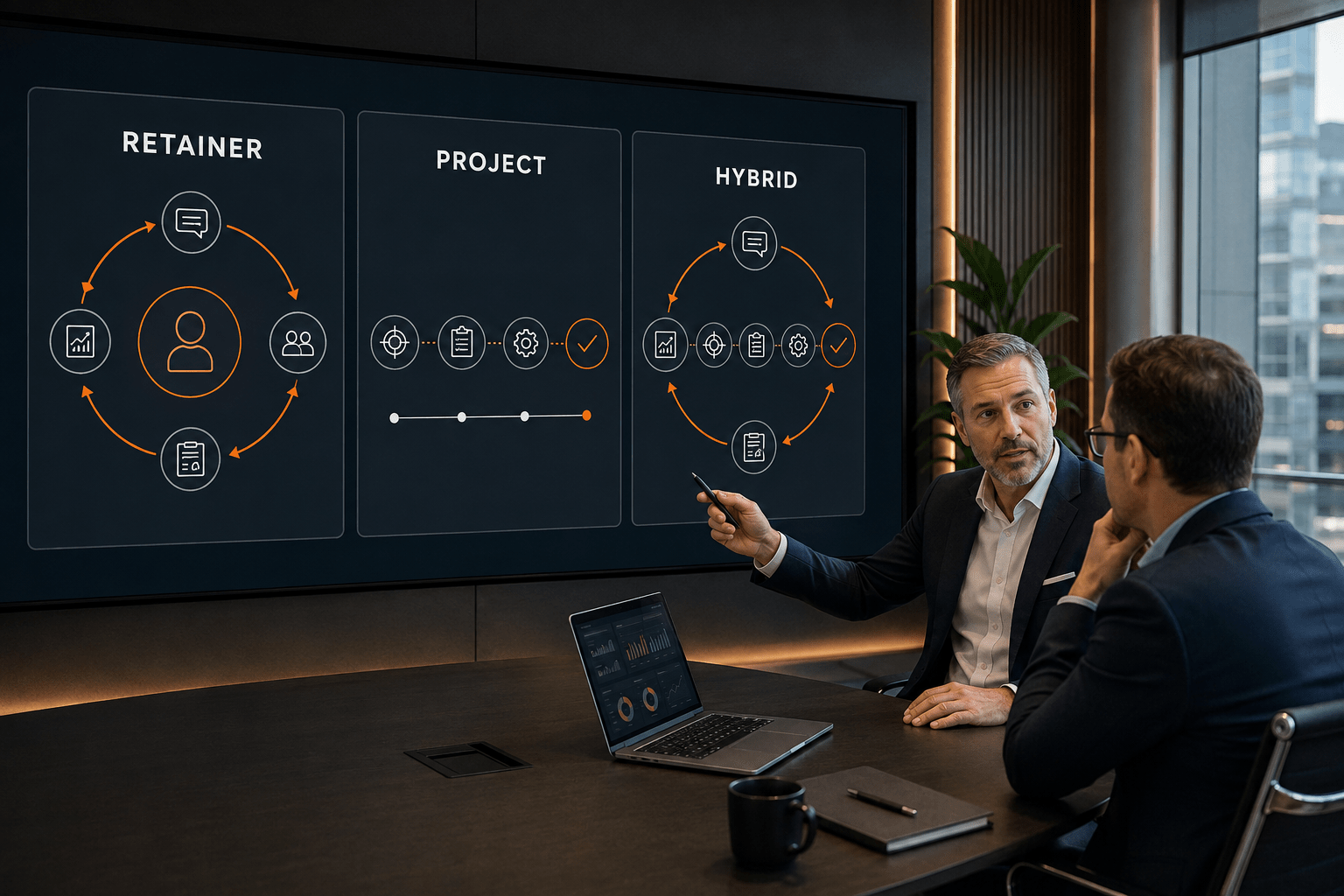
Three models cover most of the market. Understanding how each one works, what it’s suited for, and where it tends to break down saves time during the evaluation process and prevents the kind of buyer regret that shows up six months into an engagement.
Monthly Retainer
A retainer means your organization pays a fixed monthly amount for ongoing security leadership and execution. It’s the most common structure for organizations with a running security program that needs consistent management over time.
Predictability is the core appeal. You know what security leadership costs each month. Compliance management, vendor risk reviews, board reporting, vulnerability oversight — all of this runs continuously without triggering new invoices or renegotiated scope.
Scoping is where retainers go wrong most often. A retainer priced below what the actual work requires puts the provider in a position where they either cut corners or find reasons to bill additional hours. One priced above what the organization actually needs bleeds budget that could go toward execution.
Before signing, get a specific list of what’s included. Compliance program management. Vendor assessments. Board-level reporting. Incident response support up to a defined threshold. If these aren’t spelled out, they’re probably not in scope at the quoted price.
Typical ranges in 2026:
- Startups and small businesses: $1,000 to $5,000 per month
- Mid-market organizations: $5,000 to $10,000 per month
- Complex environments with active compliance obligations: $10,000 or more per month
One thing worth checking before signing: overage billing. Retainers often have hour caps, with additional work billed at $250 to $400 per hour. A security incident mid-month can burn through a month’s worth of included hours quickly.
Project-Based
A project engagement covers a specific scope of work with a defined deliverable and end date. Security assessments, gap analyses against compliance frameworks, policy buildouts, SOC 2 readiness preparation — these fit the project structure well.
The model works when the problem is genuinely bounded. A company that needs a baseline risk assessment before deciding how to build its security program, or an organization preparing for a first ISO 27001 audit with an internal team ready to manage the program afterward, has a problem that suits project-based work.
Where it consistently fails is when organizations treat it as a permanent solution to an ongoing need. A policy buildout project ends when the documents are delivered. Policies need to be maintained, updated when regulations change, and tested when incidents happen. Six months after a project closes, the documentation is already drifting from how the organization works.
Project-based vCISO work runs from roughly $5,000 for a focused gap analysis up to $50,000 or more for comprehensive readiness programs covering multiple frameworks. Scope and timeline drive the number.
Change orders are the main financial risk. Projects that seem well-defined often develop complexity once the work starts. Understanding how out-of-scope requests get handled before engagement begins prevents friction later.
Hybrid
A hybrid structure combines a base retainer covering ongoing security leadership with defined project components for specific, time-bound initiatives. It’s the most flexible model and the most common for mid-market organizations with both an ongoing security program and periodic certification or buildout work.
A typical hybrid looks like this: a monthly retainer covers continuous compliance management, vulnerability oversight, and board reporting. When the organization decides to pursue ISO 27001 certification, a scoped project component gets added to cover the certification preparation specifically. Once the certification is complete, that component drops off.
Organizations going through acquisitions often need this structure. The ongoing security program continues under the retainer. Assessing and integrating the acquired entity’s security posture is a defined project with a timeline and specific deliverables.
The main thing to get right in a hybrid agreement is the boundary between components. Which work belongs to the retainer? Which triggers the project billing? What happens when a piece of work spans both? Vague language here creates billing disputes and scope confusion.
The Question That Matters More Than the Model
Pricing model choice is secondary to something most buyers don’t ask directly: is this engagement advisory or does it include implementation?
An advisory engagement means the vCISO provides direction. Your team executes. The vCISO assesses the risk, sets the priorities, builds the roadmap. Getting the controls in place, writing the policies, collecting the evidence — that stays with your internal staff. This model costs less.
An implementation engagement means the provider’s team does the work. Policies get written by them. Controls get configured by them. Compliance evidence gets collected and organized by them. This costs more.
For an organization with a capable security team that needs strategic leadership, advisory works. For an organization without internal security staff, advisory produces a roadmap with nobody to execute it. The program sits on paper while the risk stays real.
Both advisory and implementation can be structured as a retainer, a project, or a hybrid. These are separate decisions. A mid-market company with no security staff choosing a hybrid implementation engagement for ISO 27001 certification will pay considerably more than a company with a mature internal team choosing an advisory retainer for strategic oversight. Neither is wrong. They’re different products for different situations.
How CISOSHARE Structures Pricing
CISOSHARE’s pricing tracks the market ranges above. Startups and SMBs start at $1,000 to $5,000 per month. Mid-market and enterprise engagements run from $10,000 per month based on complexity.
Their primary model for ongoing security leadership is the retainer, with scope customized per organization. Specific initiatives — a third-party risk management buildout, security architecture work, certification preparation — get defined as discrete components rather than open-ended additions to the base scope.
The pricing conversation at CISOSHARE happens after understanding what the organization actually needs, not before. That means model, scope, and resource requirements get worked out first. The number follows from that.
For context on what the work looks like once an engagement starts, the vCISO first 90 days guide covers the typical milestone sequence. For the full cost picture across service models, the fractional CISO cost guide covers market ranges and what drives variation.
FAQ
Is retainer or project better for a first vCISO engagement?
Depends what the organization is trying to accomplish. A bounded deliverable — a security assessment, a compliance gap analysis, a policy buildout — suits a project. Continuous security leadership for a running program suits a retainer. Starting with a defined project often makes sense as a way to scope what an ongoing retainer should include.
What’s typically excluded from a standard retainer?
Third-party audit fees for certifications like SOC 2 or ISO 27001, formal penetration tests, and incident response work beyond a defined hour threshold usually sit outside retainer scope. Get a list of exclusions in writing before signing.
How often should retainer scope be revisited?
At minimum annually, or whenever the organization’s security requirements change significantly. A company that was pre-SOC 2 when the retainer started has different needs after certification. Scope that made sense at 100 employees may not serve a 400-employee organization without adjustment.
CISOSHARE structures vCISO pricing based on what each organization actually needs. Schedule a call to talk through the right model for your situation.