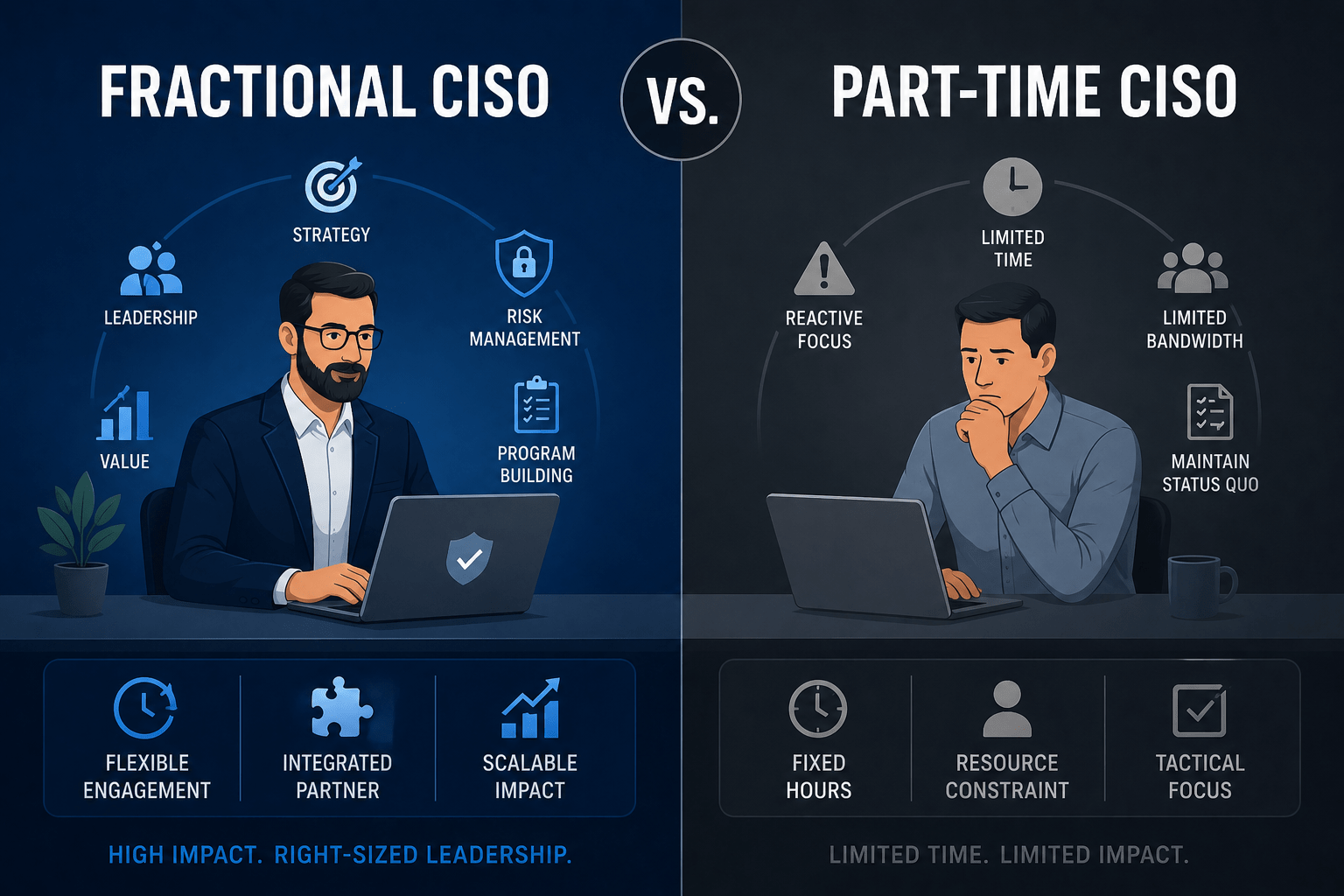
The terms get used interchangeably so often that most people assume they mean the same thing. They don’t. And the difference isn’t just semantic; choosing the wrong model for your organization can leave you with expensive security leadership that doesn’t actually solve your problem.
Here’s the short version: a fractional CISO is typically an internal hire who divides their time between security and other responsibilities. A part-time CISO is an external hire or contractor who works a reduced schedule. A vCISO and CISO-as-a-Service are both outsourced models and usually what growing organizations actually need.
Understanding which model fits your situation is worth spending time on before you start a search.
The Fractional CISO: What It Actually Means
In the most widely used definition, a fractional CISO is a cybersecurity executive who works on a part-time or shared basis, often onsite, allocating a portion of their time to security leadership alongside other responsibilities.
In practice, this often means one of two things. Either the organization has assigned the CISO role to an existing executive, the CTO, COO, or IT Director, who now carries both their original title and security accountability. Or the organization has hired someone specifically to serve as CISO, but at a reduced commitment level, where security is part of their role but not the entirety of it.
Both arrangements have a real ceiling on what they can deliver.
When a non-security executive takes on CISO responsibilities, they’re usually doing it without the background to make confident security decisions and without the time to stay current on the threat landscape. They satisfy the compliance requirement of having a named security leader. They don’t necessarily build a security program that works.
When someone is hired to split their time between security and another function, the reality of organizational dynamics means security almost always gets deprioritized during any period of competing demands. And those periods are constant.
The Part-Time CISO: Where It Fits
A part-time CISO is an external hire, an independent consultant or contractor who provides security leadership for a defined number of hours per week or month. They’re not a full-time employee. They’re usually a senior security professional who works with multiple organizations simultaneously.
This model fills a specific gap: organizations that need security leadership from someone with genuine CISO-level expertise but don’t have enough work or budget to justify a full-time hire. The part-time CISO brings outside perspective, deep experience, and direct accountability for a focused scope of work.
What they typically don’t bring is a supporting team. A part-time CISO is one person. They can develop a strategy, advise on decisions, build a roadmap, and review policies. Executing that roadmap, implementing controls, managing vendors, running compliance programs, and handling incidents falls back on the organization’s internal team. If that team is thin or doesn’t have security expertise, a solo part-time CISO creates a gap between strategic intent and operational reality.
vCISO vs. CISO-as-a-Service: The Outsourced Models
Both vCISO and CISO-as-a-Service are outsourced models, which means the security leadership comes from an external provider rather than a hire.
A vCISO provides the security leader. That leader brings strategy, governance, risk oversight, and direction for the security program. They’re remote, typically serving multiple clients, and engage based on an agreed scope and cadence. The vCISO is the right fit when an organization has internal resources who can execute on security work but need strategic direction from someone with CISO-level experience.
CISO-as-a-Service provides the leader plus a team. It’s the model organizations should reach for when they need both the strategic oversight and the execution capacity because they don’t have a security team internally, because their current IT team isn’t equipped to run a security program, or because the volume of security work exceeds what a single leader can direct and a small internal team can handle.
The distinction matters because most growing organizations that think they need a fractional CISO actually need CISO-as-a-Service. They don’t just need someone to tell them what to do. They need the people to do it.
Side-by-Side Comparison
| Model | Who Provides It | Team Included | Best For |
|---|---|---|---|
| Fractional CISO | Internal hire (split role) | No | Organizations that have an executive willing to take on security alongside another function |
| Part-Time CISO | External contractor | No | Organizations with a security-capable internal team that needs leadership direction only |
| vCISO | External provider (one leader) | No | Organizations with internal security resources needing strategic guidance |
| CISO-as-a-Service | External provider (leader + team) | Yes | Organizations without a security team that need both leadership and execution |
The Hidden Cost of Getting This Wrong
Choosing the wrong model doesn’t just create inefficiency. It creates a false sense of security that can be more dangerous than having no security program at all.
An internal executive assigned CISO duties may check the compliance box while leaving real gaps unaddressed — because they don’t have the expertise to see them and don’t have the time to investigate. A part-time CISO who builds an excellent roadmap but has no team to execute it produces a document, not a security program. An organization that thinks its fractional arrangement is working because they have a named CISO discovers the real state of affairs only when something goes wrong.
The organizations that consistently build effective security programs are the ones that match the model to the actual problem. If you don’t have a security team, don’t start with a single leader. Start with a model that gives you both leadership and execution from day one.
When Each Model Makes Sense
Fractional CISO (internal, split-role) makes sense for very small organizations — typically under 50 people — where security responsibilities are limited in scope, compliance requirements are minimal, and an existing leader with some security background can realistically manage both roles. This works as a transitional arrangement. It rarely works as a long-term security strategy.
Part-time CISO (external contractor) makes sense when the organization already has IT staff capable of executing on security work and needs experienced strategic leadership to direct them. The internal team can patch, configure, monitor, and respond. What they need is someone to set priorities, make risk decisions, and own the security roadmap.
vCISO makes sense for the same scenario at a slightly larger scale, or when the organization wants the benefits of outsourced expertise — broader experience, no single point of failure, no turnover risk — but has the internal capacity to handle execution.
CISO-as-a-Service makes sense for growing organizations, nonprofits, and mid-size companies that need security leadership and don’t have a team to execute. It’s also the right model when compliance requirements are growing faster than the organization’s ability to manage them internally — when clients are asking for security questionnaire responses, when SOC 2 or ISO 27001 is on the horizon, when a breach or near-miss has revealed how unprepared the organization actually is.
The Question Worth Asking First
Before choosing a model, answer one question honestly: Does your organization have the internal capacity to execute on security work, or does it need someone else to do that execution?
If your IT team can handle implementation and you need strategic direction, a part-time CISO or vCISO is probably the right fit. If you need both strategy and execution — which is true of most growing organizations — CISO-as-a-Service is the answer.
A good provider will tell you which model fits your situation. If they’re pushing you toward a model before understanding your organization’s internal capability, that’s a signal worth paying attention to.
How CISOSHARE Approaches This
CISOSHARE offers both vCISO and CISO-as-a-Service, depending on what the organization actually needs. Their vCISO service provides strategic leadership for organizations that have internal security resources. Their CISO-as-a-Service provides leadership plus a team for organizations that need both.
What they don’t do is assign a single consultant and call it done. Their view — built from working with hundreds of organizations — is that a successful security program is more than a one-person show. An individual security leader, without a team around them, cannot design and implement an entire program alone. The service model they bring matches the scale of the problem.
One client came to CISOSHARE after cycling through several CISO hires, each of whom moved on months after being engaged. CISOSHARE stepped in, provided immediate impact on the most pressing issues in the security program, and took over operational work that had been falling on internal resources — all for a fraction of what prior hires had cost. Another client, a small company experiencing rapid growth, had no formal security program and was under client pressure to demonstrate security compliance. CISOSHARE built the program, handled the compliance response, and removed that pressure from the team entirely.
For a deeper look at what vCISO and CISO-as-a-Service actually cost and how to evaluate providers, see our vCISO evaluation checklist. If you’re trying to decide between outsourcing security leadership and hiring internally, the CISO as a Service vs. hiring in-house comparison covers the full tradeoff. And if you’re not sure whether your organization even needs a fractional CISO yet, the 5 signs you’ve outgrown DIY security is worth reading first.
FAQ
Is a fractional CISO the same as a vCISO?
Not exactly. The terms overlap in common usage, but the clearest distinction is source: a fractional CISO is typically an internal hire working part-time on security alongside other duties, while a vCISO is an outsourced security leader provided by an external firm. In practice, many people use “fractional CISO” to mean any part-time security leadership arrangement, including outsourced ones.
Can a fractional CISO work as a long-term solution?
It depends on your organization’s size and security requirements. For very small organizations with limited compliance obligations, a fractional arrangement can work long-term. For organizations with growing client demands, regulatory obligations, or security program maturity goals, it typically becomes a bottleneck.
What should I budget for fractional CISO or vCISO services?
Part-time CISO arrangements and vCISO engagements typically range from $1,000 to $5,000 per month for SMBs, scaling with scope and program complexity. CISO-as-a-Service engagements that include a supporting team run higher. The right starting point is understanding your current state — a security program assessment is usually the first step.