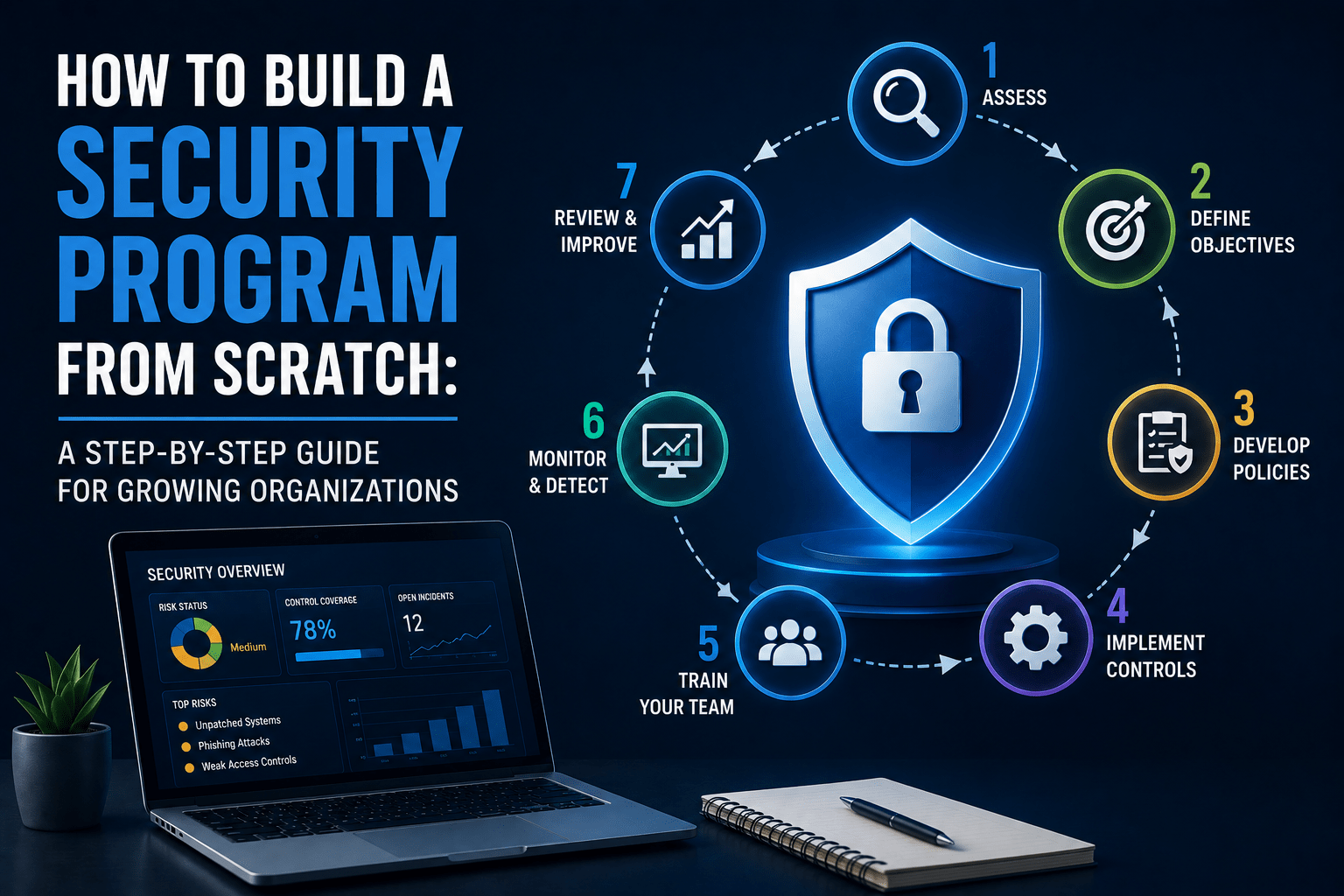
A security program is a structured system of policies, processes, people, and technology that protects your organization’s information and aligns security efforts with business objectives. It’s not a product you buy or a project you complete — it’s an ongoing operational function that evolves with your organization.
If your company has grown past the point where ad-hoc security decisions work but doesn’t yet have a formal program in place, this guide walks you through building one from the ground up. No prior security expertise required
Why You Need a Program, Not Just Tools
There’s a common misconception that security means buying the right technology. A firewall, an antivirus solution, and maybe a password manager. But there is no correlation between spending money on security technologies and having an effective program. Organizations that spend heavily on tools without a program often have weaker security than those that invest in structure first.
A security program provides the context that makes everything else work. It defines what you’re protecting, who’s responsible, what the rules are, and how you’ll respond when something goes wrong. Tools are only effective when they’re deployed within a program that gives them purpose and direction.
A program also unlocks business opportunities. Enterprise clients, government agencies, and healthcare organizations increasingly require proof of a managed security program before signing contracts. Organizations that can demonstrate a structured security approach win business that competitors without one cannot.
Step 1: Establish Your Security Framework
The framework is the foundation of your security program. Think of it as the table of contents — it lists out every requirement your organization needs to meet, drawn from business requirements, regulations, industry standards, and best practices.
This isn’t about picking one standard and following it blindly. An effective security framework is more like a framework of frameworks — aggregating requirements from NIST, ISO 27001, HIPAA, PCI DSS, CMMC, state regulations, and any contractual obligations specific to your business. Not every requirement from every standard will apply to you. The framework identifies which ones do and organizes them into a coherent structure.
For growing organizations building their first program, starting with NIST Cybersecurity Framework as a baseline is practical. It covers the core functions — Identify, Protect, Detect, Respond, Recover — and maps well to most other standards. As your compliance requirements grow, you layer additional framework requirements on top.
Step 2: Define Governance and Roles
Governance answers the question: who is responsible for what? Without clear governance, security responsibilities fall through the cracks or pile onto people who aren’t equipped to handle them.
Define the roles and responsibilities of your security program in relation to other parts of your business. Specifically, answer these questions: who owns the security program overall? Who makes risk decisions? Who approves policies? Who handles day-to-day security operations? Who responds to incidents? How does the security function report to leadership?
For growing organizations without a full-time security leader, this is where a vCISO or CISO-as-a-Service engagement fills the gap. The vCISO provides the strategic leadership and governance structure while your team handles operations within the framework they establish.
Document your governance structure in a program charter that defines scope, authority, and reporting relationships. This charter becomes the anchor for everything that follows.
Step 3: Build Your Policy Foundation
Policies define security for your organization at a high level. They state what is required, who it applies to, and the consequences of non-compliance. Policies are the rules. Procedures and standards — which come later — describe how those rules are implemented.
Start with these core policies: information security policy (the overarching policy that establishes management’s commitment and program scope), acceptable use policy (how employees can use organizational systems and data), access control policy (who gets access to what and how access is granted, modified, and revoked), data classification and handling policy (how data is categorized and protected based on sensitivity), incident response policy (what happens when a security event occurs), vendor and third-party risk policy (how you evaluate and manage supplier security), and password and authentication policy (authentication requirements including multi-factor authentication).
Policies must reflect what your organization actually does — not aspirational statements copied from a template. An auditor will test whether your practices match your policies. A policy that says you do something you don’t is worse than having no policy at all.
Step 4: Conduct a Risk Assessment
With your framework, governance, and policies established, you need to understand your actual risk landscape. A risk assessment identifies what could go wrong, how likely it is, and what the impact would be.
Start by inventorying your critical assets — data, systems, processes, and people. Map where sensitive data lives and how it moves. Identify the threats most relevant to your industry and size. Assess vulnerabilities in your current environment. Then score each risk based on likelihood and impact.
The output is a risk register that prioritizes your risks and a treatment plan that specifies how each risk will be addressed — mitigate, transfer, accept, or avoid. This risk assessment drives your control implementation priorities in the next step.
Don’t over-engineer this. A practical, focused risk assessment that covers your top 20–30 risks is more valuable than a comprehensive exercise that identifies 500 risks and paralyzes your team.
Step 5: Implement Controls
Controls are the specific measures — technical, administrative, and physical — that reduce risk. Your risk assessment tells you which controls to prioritize. Your framework tells you which controls are required.
Technical controls include multi-factor authentication, encryption at rest and in transit, endpoint protection, network segmentation, vulnerability scanning, logging and monitoring, and backup and recovery systems.
Administrative controls include security awareness training, background checks, change management processes, access reviews, and vendor risk assessments.
Physical controls include facility access restrictions, visitor management, clean desk policies, and equipment disposal procedures.
Implement controls in priority order based on your risk assessment. Address the highest risks first. Document each control — what it does, how it’s configured, who’s responsible, and how it’s monitored. This documentation becomes critical for compliance and audits.
Step 6: Build Operational Processes
Controls need processes to function consistently. A vulnerability scanner is a tool. Vulnerability management — with defined cadence, ownership, remediation tracking, and reporting — is a process.
Build processes around the core operational areas of your security program: vulnerability management with regular scanning, prioritization, and remediation tracking; incident response with documented procedures, communication plans, and regular tabletop exercises; access management with provisioning, modification, and deprovisioning workflows; vendor risk management with assessment procedures for new and existing third parties; security awareness with ongoing training, phishing simulations, and compliance tracking; and change management with security review procedures for system and configuration changes.
Each process needs defined steps, responsible owners, expected cadence, and metrics for measuring effectiveness. Properly documented and regularly updated processes ensure your policies are carried out consistently and repeatably.
Step 7: Measure, Report, and Improve
A security program without metrics is a program without accountability. Establish key metrics that tell you whether the program is working and where it needs improvement.
Track metrics like mean time to remediate vulnerabilities, percentage of employees completing security training, number and severity of security incidents, risk assessment completion status, compliance audit findings and remediation, and vendor risk assessment completion rates.
Report these metrics to leadership regularly — monthly or quarterly, depending on your organization’s cadence. Translate technical metrics into business impact so decision-makers can connect security investment to outcomes.
Use the data to continuously improve. If vulnerability remediation is slow, investigate why. If phishing simulation failure rates are high, adjust training. If incident response tabletops reveal gaps, update procedures. A healthy security program is never finished — it evolves with your organization, threat landscape, and business requirements.
How CISOSHARE Builds Security Programs
CISOSHARE’s managed security program services provide everything you need to build and maintain an effective cybersecurity program. Their approach uses a blend of people, processes, and technology with a proven development methodology to build a program customized to your organization’s unique needs and requirements.
Their methodology starts with the foundational components — framework, governance, and policies — then builds outward to risk management, controls implementation, and operational processes. Within months, they will build a custom and comprehensive program tailored to your goals and business drivers.
What sets CISOSHARE apart is its implementation approach. They don’t advise and leave. As one client, Beta Research Corp, described, with CISOSHARE’s help, they were able to quickly secure new business and solve a core business problem — proving they could protect client data. Their security program became a tool for winning and retaining business.
With 20+ years of experience and a learning-and-teaching culture at their core, CISOSHARE focuses on educating your team alongside building the program — so you develop internal capability while benefiting from external expertise.
FAQ
How long does it take to build a security program from scratch?
A functional baseline program can be established in 3–6 months. Full maturity with documented processes, tested controls, and compliance readiness typically takes 9–12 months. CISOSHARE’s managed approach accelerates this timeline through proven methodology and experienced resources.
Do we need a full-time CISO to build a security program?
No. A vCISO or CISO-as-a-Service provides the leadership needed to build and manage the program without the cost of a full-time executive hire. This is the most practical path for growing organizations and nonprofits.
What’s the difference between a security program and a security framework?
A framework is one component of a program — it defines the requirements and structure. A security program is the complete system including governance, policies, risk management, controls, processes, people, and ongoing operations built on top of that framework.