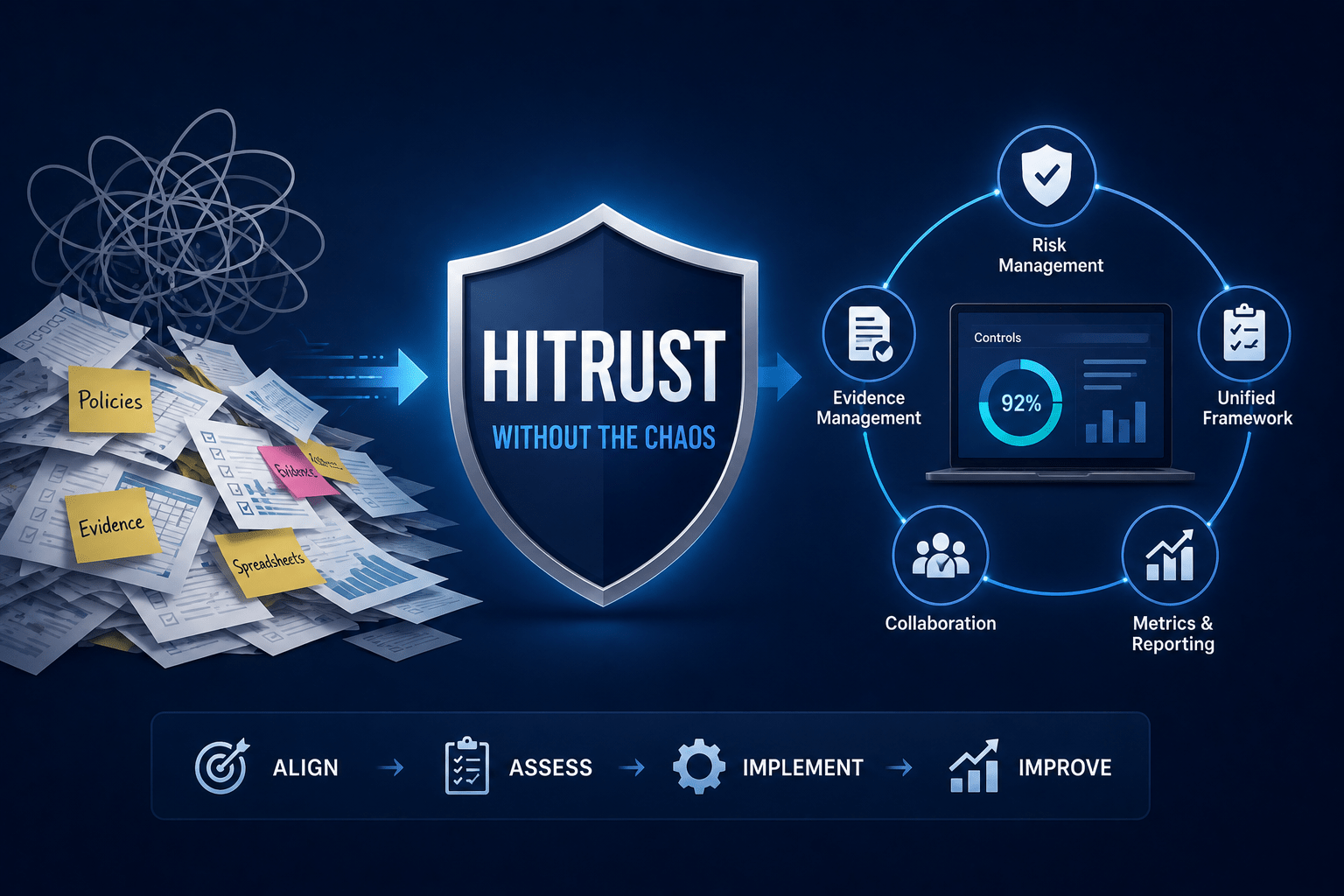
HITRUST has a reputation for being one of the most demanding certification processes in healthcare security. That reputation is mostly earned. The Common Security Framework covers over 150 control categories, draws from more than a dozen regulatory standards, and requires documented evidence across thousands of individual control statements. Organizations that approach it without a clear plan spend months chasing requirements they didn’t see coming and often end up delaying certification by a year or more.
But the chaos isn’t inevitable. It’s usually the product of one mistake: treating HITRUST as a standalone compliance project rather than building it into the security program you should be running anyway.
What HITRUST CSF Actually Is
The HITRUST Common Security Framework is a certifiable security framework built specifically for organizations in healthcare and any sector handling sensitive health-related data. It takes requirements from HIPAA, PCI DSS, NIST, ISO 27001, SOC 2, and other standards and organizes them into a single, prescriptive set of controls.
That integration is what makes it valuable and what makes it complex.
When a healthcare organization achieves HITRUST certification, it’s not just demonstrating HIPAA compliance. It’s demonstrating that controls are in place that satisfy multiple regulatory and industry standards simultaneously, that those controls have been independently validated, and that the organization has a functioning security program, not just a collection of policies. For healthcare providers, health plans, business associates, and health technology companies, HITRUST has become the gold standard third-party validation of security posture. Enterprise health plan partners and major hospital systems increasingly require it as a condition of doing business.
Who Actually Needs It
HITRUST is most commonly required for organizations that are business associates to large health plans, hospital systems, or other covered entities. If your enterprise client in healthcare has asked you to complete a HITRUST assessment or if you’ve lost a deal because you couldn’t demonstrate it, that’s the clearest signal.
Beyond direct requirements, HITRUST makes sense when your organization handles significant volumes of protected health information and wants a consolidated certification that satisfies multiple frameworks at once. For a healthcare technology company or a health services organization that would otherwise need to manage separate HIPAA audits, SOC 2 assessments, and PCI compliance reviews, HITRUST can reduce that overhead significantly by addressing all of them within a single framework and a single certification process.
It’s also increasingly relevant for nonprofits that manage health-related programs, participate in California’s Data Exchange Framework, or work as subcontractors to healthcare delivery organizations. The compliance requirements flow downstream, and HITRUST is how many of those organizations demonstrate they meet them.
The Three Assessment Options
HITRUST offers three paths to certification, and choosing the right one is the first decision that shapes your entire preparation.
e1 (Essentials): The entry-level option covers 44 essential controls. It’s designed for organizations with lower risk profiles or those just beginning their HITRUST journey. The assessment is faster and less expensive than the higher tiers, but it satisfies a narrower set of requirements. Many healthcare clients won’t accept e1 as sufficient — check what your specific clients or contracts require before committing to this path.
i1 (Implemented): Covers 182 controls and is validated by a HITRUST-authorized external assessor. This is the most commonly required level for business associates and health technology companies. The i1 is what most organizations mean when they say “HITRUST certified.” It’s also what most healthcare enterprise clients expect to see.
r2 (Risk-Based): The most comprehensive option, covering 375+ controls with a full validated assessment. Designed for organizations with higher risk profiles, more complex environments, or those serving regulated entities with the most rigorous requirements. R2 certification is valid for two years with an annual interim review.
Most growing organizations should plan for i1. If you’re unsure which tier is right for your situation, a readiness assessment will answer that before you’ve committed resources to the wrong path.
Why Organizations End Up in Chaos
The common failure modes in HITRUST preparation aren’t mysterious. They happen for predictable reasons.
Starting without a complete picture of your environment:
HITRUST controls are scoped to the systems and processes that handle sensitive health data. If you haven’t mapped exactly what those systems are, who accesses them, where data flows, and which third parties touch it, you’re scoping your assessment blindly. Organizations that do this end up discovering significant in-scope systems partway through the process, which resets large portions of their preparation work.
Underestimating documentation requirements:
HITRUST requires documented policies, procedures, and evidence for each control. “We do this” is not evidence. Screenshots, configuration exports, audit logs, training records, signed acknowledgments — these are what assessors look at. Organizations that have good security practices but haven’t documented them consistently spend the most time in remediation.
Treating it as an IT project:
HITRUST controls span physical security, HR processes, third-party management, incident response, and executive governance — not just technical controls. When preparation is delegated entirely to IT, the non-technical control areas are usually the last to get addressed and often the ones that delay certification.
Not starting remediation early enough:
A self-assessment identifies the gaps. Remediating them takes time — sometimes months, depending on what’s missing. Organizations that complete their self-assessment three months before their target certification date are setting themselves up to either miss the deadline or certify with open corrective action plans.
Working with a consultant who doesn’t understand your business. Generic HITRUST guidance tells you what controls are required. A good advisor tells you how to satisfy those controls efficiently, given your specific environment, your team’s capacity, and your current security posture. That context is the difference between a streamlined path and a year of confusion.
The Right Way to Build Toward HITRUST
The organizations that reach certification on schedule without burning out their teams approach it the same way.
They start with a self-assessment before committing to a certification timeline. The self-assessment maps their current controls against HITRUST requirements, identifies gaps, and produces a remediation roadmap with realistic timelines. This is the step that prevents the midway surprises.
They address their security program foundation first. HITRUST is certifying that you have a real security program, governance, risk management, policies, technical controls, and operational processes. Organizations that already have this foundation in place spend significantly less time in remediation than those trying to build the program and satisfy HITRUST simultaneously.
They treat control documentation as an ongoing practice, not a pre-audit scramble. Evidence collection that runs continuously is far less disruptive than gathering months of evidence in the six weeks before your assessment. This is one area where a structured security program makes HITRUST dramatically easier if your program already produces the evidence HITRUST requires; certification becomes a matter of organizing it, not creating it.
They involve their assessor early. HITRUST-authorized assessors can identify interpretation questions before they become problems. Working with your assessor during preparation, not just at the assessment itself, prevents costly rework from control misinterpretations.
How HITRUST Fits Into a Broader Compliance Strategy
If your organization needs HITRUST, there’s a good chance you also have obligations under HIPAA, and possibly SOC 2, PCI DSS, or state-level regulations. The overlap between these frameworks is substantial.
HITRUST i1 already incorporates HIPAA requirements. The access controls, encryption requirements, incident response procedures, and workforce training that HITRUST demands are the same ones HIPAA requires. Building your security program to satisfy HITRUST means you’re building it to satisfy HIPAA simultaneously.
The same logic applies to SOC 2. Access control, availability, and confidentiality criteria in SOC 2 map closely to HITRUST control categories. Organizations pursuing both can build a unified control set rather than maintaining separate programs.
For a full picture of how HITRUST intersects with your other compliance obligations, the Complete Cybersecurity Compliance Checklist covers HIPAA, SOC 2, ISO 27001, CMMC, and HITRUST in one place. If you’re working through HIPAA requirements specifically, the HIPAA compliance guide covers what healthcare organizations need to have in place. And the security program guide covers the program foundation that makes every certification path easier.
How CISOSHARE Supports HITRUST Certification
CISOSHARE’s HITRUST certification services guide organizations through the process from self-assessment to certification — without the confusion that trips up most first-time programs.
Their security experts advise on what to include in the self-assessment, identify the control requirements that apply to the organization’s specific environment, and generate a clear action list for policy and process remediation. They then support the team through remediation, review the environment for readiness, and prepare for formal validation with an authorized CSF assessor.
The approach is the same one CISOSHARE brings to all compliance work: build a strong security program first, then demonstrate compliance as a natural output of that program — rather than building a compliance presentation that has nothing underneath it. One client, after a complex spin-off from two multi-billion dollar corporations, worked with CISOSHARE to build a complete security program for new data center operations — and achieved the required certifications as a result of the program, not despite missing one.
That’s the model. HITRUST certification is the outcome of a well-built security program, not a separate exercise you bolt on top of one.
FAQ
How long does HITRUST certification take?
Most organizations should plan for 9–18 months from initial self-assessment to certification, depending on their current security maturity and the assessment tier they’re pursuing. Organizations with a solid existing security program typically move faster. Starting with a self-assessment is the only reliable way to set a realistic timeline.
What’s the difference between HITRUST and SOC 2?
SOC 2 is an attestation report that evaluates controls against the AICPA’s Trust Services Criteria. HITRUST is a certification against the Common Security Framework, which incorporates HIPAA, PCI DSS, NIST, ISO 27001, and SOC 2 requirements. HITRUST carries more weight in healthcare specifically. Many organizations pursue both — the control overlap is significant enough that building toward HITRUST provides a strong foundation for SOC 2 as well.
Can we do HITRUST if we don’t have a security program yet?
You can start the process, but a missing security program foundation will show up immediately in the self-assessment. The most efficient path is building the foundational security program first — governance, policies, risk management, and core technical controls — then layering HITRUST certification on top of it.